
Statement
INSIGHT UK’s ‘Holi Attack’ Claims Are False and Risk Inciting Community Tensions
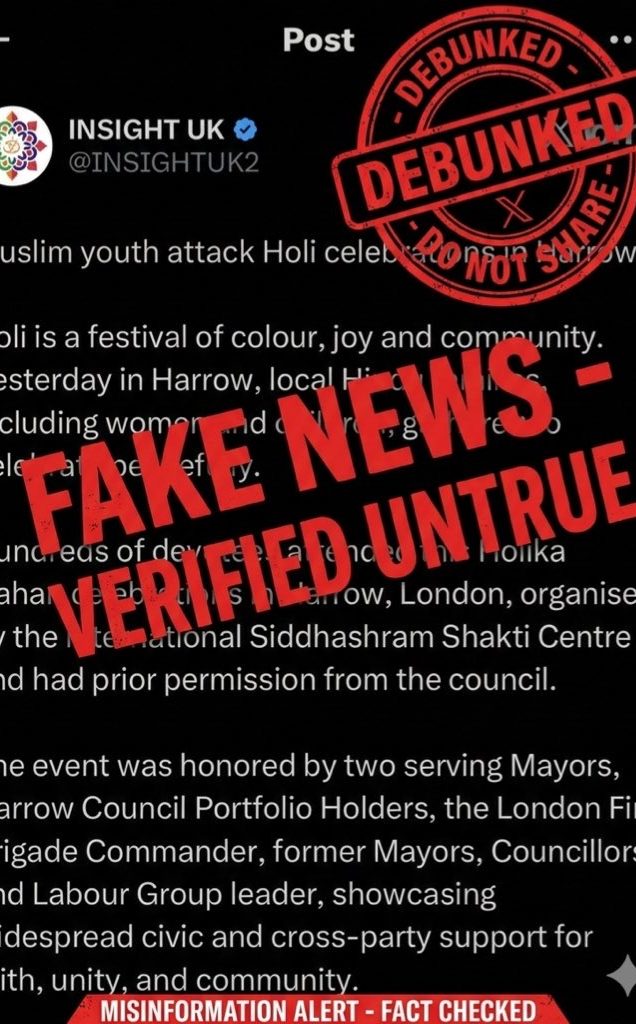
The United Kingdom Indian Muslim Council (UK-IMC) debunks the fake news circulated by Hindutva outfit INSIGHTUK that stokes up tensions between communities. It also expresses serious concern over the circulation of misleading claims following a disturbance that occurred in Harrow, London.
Initial reporting described the incident as a brawl at a Holi celebration near the former Harrow Civic Centre car park, after which police were called and a 14-year-old boy was arrested in connection with the disturbance. The incident was first reported by local outlet Harrow Online, which did not attribute the incident to any particular religious community.
However, shortly afterwards, several online platforms and activists associated with Hindutva networks, including INSIGHT UK, began circulating claims that Muslim youths had attacked a Holi celebration. These allegations were widely shared online despite the absence of verified evidence.
Crucially, communication circulated by Harrow Council clarified that police do not believe the incident was directed at the Hindu community, contradicting the narrative promoted on social media.
UK-IMC warns that spreading unverified and inflammatory claims risks stoking unnecessary communal tensions and undermining long-standing relations between communities in the United Kingdom. We urge responsible reporting, verification of facts, and restraint in amplifying narratives that could harm social cohesion.
UK-IMC remains committed to countering misinformation, challenging Islamophobia, and promoting constructive engagement between communities.
Statement
UK-IMC welcomes independent inquiry call to recognise radical and militant Hindutva as a form of ‘extremism’; Reiterates findings of the independent inquiry published by UK-IMC and CPF
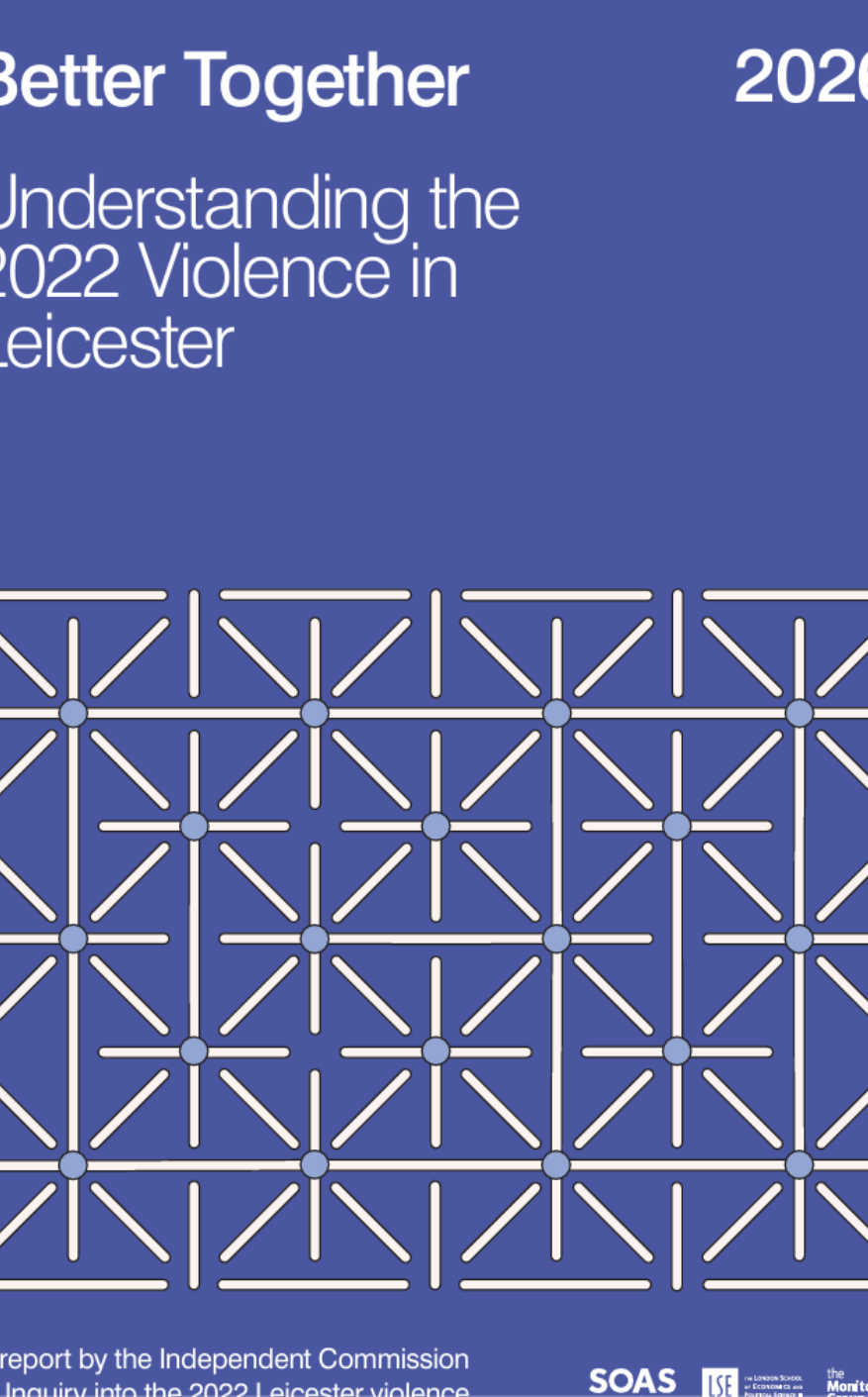
The UK-Indian Muslim Council (UK-IMC) welcomes the key findings of the Independent Commission of Inquiry into the violence that took place in Leicester in 2022 led by academics at SOAS, University of London and LSE, and chaired by international human rights expert Professor Juan Méndez. The inquiry identifies Hindutva extremism as a primary driver of the 2022 Leicester unrest. A link to the inquiry report is found at https://www.leicesterinquiry.org/report
The inquiry finds that “the trigger for the sequence of escalating events was the violent attack in May 2022 on a young Muslim man by a group of Hindu youths,” and places this within the wider context of Hindutva extremism, which has shaped communal narratives and was reflected in public slogans and processions.
UKIMC further welcomes the inquiry’s determined attention to recognising radical and militant Hindutva (Hindu nationalism, Hindu supremacism) as a form of extremism. The report concludes that “Hindutva ideology meets the criteria in the UK Government’s 2024 definition of extremism,” including activity in the UK to “radicalise, indoctrinate and recruit others to an ideology based on violence, hatred or intolerance,” as well as attempts to “glorify or excuse violence and terror in India against minorities and minority institutions.”
The report’s call for “political will to confront Hindutva extremism” is both timely and necessary. UKIMC supports this call and emphasises that addressing organised supremacist ideologies requires consistency, clarity, and resolve from policymakers and public authorities.
These findings reinforce the conclusions previously set out in the report published by UKIMC and Community Policy Forum (CPF). Both reports identify the transnational influence of Hindutva activism and its role in spreading divisive and extremist ideologies within local communities in the UK. A link to the report can be found at https://www.ukimc.org/leicester-inquiry
The inquiry also concludes that “this process of facing and challenging Hindutva supremacism in the UK diaspora… must take place,” particularly where attempts are made to “control the spaces of Hindu religious beliefs and practices and turn them into support for extremist and violent ideologies.” The inquiry makes a constructive appeal to Hindu religious and community organisations to “work steadfastly and patiently to distance their religious, spiritual, devotional and sampraday traditions from political Hindutva supremacist ideas and organisations,” and to identify and isolate Hindutva organisations such as Insight UK and consistently challenge them.
The Inquiry identifies Insight UK as a significant actor in the spread and amplification of Hindutva-linked communal polarisation, particularly through selective and misleading narratives about the unrest. The report states that Insight UK’s narratives were often “based on disinformation, misinformation, highly selective information, inflammatory claims, and sometimes outright fabrications and defamation of individuals.”
The report says Insight UK promoted a narrative that Hindus in Leicester were under organised attack by “Islamists,” while minimising or dismissing evidence of Hindutva influence and anti-Muslim hostility. It cites an example of Insight UK’s framing: “A dangerous plot. This is not a Hindu-Muslim clash, this is an outright attack on Hindus by #Islamists.”
The inquiry is equally clear in identifying serious concerns regarding policing and institutional responses. It notes that “a swift resolution of the May 2022 attack might have made a real difference” and highlights “instances of apparent police failures to investigate fully serious cases of violence,” significant shortcomings in intelligence that “could have helped prevent the violence,” and a failure to apprehend individuals reportedly carrying weapons on 17 September. The report also documents “some heavy-handedness and unnecessary aggression in police actions towards Muslims” and points to a wider “serious lack of knowledge and understanding related to communalism, Hindutva supremacism, and its damaging effects on South Asian communities in the UK.” We are pleased that Leicestershire Police have released a statement acknowledging the need to look at the report and seek to improve. This is a great step forward, and we recognise the efforts that Leicestershire Police is taking in understanding the issue of Hindutva extremism.
UKIMC regards this report as an important turning point and endorses the Inquiry’s principled distinction between faith and supremacist politics. UKIMC reiterates its commitment to working alongside all those with the Hindu community who reject extremism in all its forms, including Hindutva extremism and the far right.
UKIMC further affirms its willingness to engage constructively with any organisation, community body, or public institution that is committed to the core principles of universal human rights, equality before the law, social cohesion, fairness, and justice for all. In our view, sustainable community relations and public trust can only be secured through principled cooperation, honest dialogue, and a consistent commitment to opposing hatred, intimidation, and supremacist ideologies wherever they arise. These are not only universal democratic values; they are also fundamental British values, and they are central to what makes us British
Statement
UK-IMC welcomes independent inquiry call to recognise radical and militant Hindutva as a form of ‘extremism’; Reiterates findings of the independent inquiry published by UK-IMC and CPF
The UK-Indian Muslim Council (UK-IMC) welcomes the key findings of the Independent Commission of Inquiry into the violence that took place in Leicester in 2022 led by academics at SOAS, University of London and LSE, and chaired by international human rights expert Professor Juan Méndez. The inquiry identifies Hindutva extremism as a primary driver of the 2022 Leicester unrest. A link to the inquiry report is found at https://www.leicesterinquiry.org/report
The inquiry finds that “the trigger for the sequence of escalating events was the violent attack in May 2022 on a young Muslim man by a group of Hindu youths,” and places this within the wider context of Hindutva extremism, which has shaped communal narratives and was reflected in public slogans and processions.
UKIMC further welcomes the inquiry’s determined attention to recognising radical and militant Hindutva (Hindu nationalism, Hindu supremacism) as a form of extremism. The report concludes that “Hindutva ideology meets the criteria in the UK Government’s 2024 definition of extremism,” including activity in the UK to “radicalise, indoctrinate and recruit others to an ideology based on violence, hatred or intolerance,” as well as attempts to “glorify or excuse violence and terror in India against minorities and minority institutions.”
The report’s call for “political will to confront Hindutva extremism” is both timely and necessary. UKIMC supports this call and emphasises that addressing organised supremacist ideologies requires consistency, clarity, and resolve from policymakers and public authorities.
These findings reinforce the conclusions previously set out in the report published by UKIMC and Community Policy Forum (CPF). Both reports identify the transnational influence of Hindutva activism and its role in spreading divisive and extremist ideologies within local communities in the UK. A link to the report can be found at https://www.ukimc.org/leicester-inquiry
The inquiry also concludes that “this process of facing and challenging Hindutva supremacism in the UK diaspora… must take place,” particularly where attempts are made to “control the spaces of Hindu religious beliefs and practices and turn them into support for extremist and violent ideologies.” The inquiry makes a constructive appeal to Hindu religious and community organisations to “work steadfastly and patiently to distance their religious, spiritual, devotional and sampraday traditions from political Hindutva supremacist ideas and organisations,” and to identify and isolate Hindutva organisations such as Insight UK and consistently challenge them.
The Inquiry identifies Insight UK as a significant actor in the spread and amplification of Hindutva-linked communal polarisation, particularly through selective and misleading narratives about the unrest. The report states that Insight UK’s narratives were often “based on disinformation, misinformation, highly selective information, inflammatory claims, and sometimes outright fabrications and defamation of individuals.”
The report says Insight UK promoted a narrative that Hindus in Leicester were under organised attack by “Islamists,” while minimising or dismissing evidence of Hindutva influence and anti-Muslim hostility. It cites an example of Insight UK’s framing: “A dangerous plot. This is not a Hindu-Muslim clash, this is an outright attack on Hindus by #Islamists.”
The inquiry is equally clear in identifying serious concerns regarding policing and institutional responses. It notes that “a swift resolution of the May 2022 attack might have made a real difference” and highlights “instances of apparent police failures to investigate fully serious cases of violence,” significant shortcomings in intelligence that “could have helped prevent the violence,” and a failure to apprehend individuals reportedly carrying weapons on 17 September. The report also documents “some heavy-handedness and unnecessary aggression in police actions towards Muslims” and points to a wider “serious lack of knowledge and understanding related to communalism, Hindutva supremacism, and its damaging effects on South Asian communities in the UK.” We are pleased that Leicestershire Police have released a statement acknowledging the need to look at the report and seek to improve. This is a great step forward, and we recognise the efforts that Leicestershire Police is taking in understanding the issue of Hindutva extremism.
UKIMC regards this report as an important turning point and endorses the Inquiry’s principled distinction between faith and supremacist politics. UKIMC reiterates its commitment to working alongside all those with the Hindu community who reject extremism in all its forms, including Hindutva extremism and the far right.
UKIMC further affirms its willingness to engage constructively with any organisation, community body, or public institution that is committed to the core principles of universal human rights, equality before the law, social cohesion, fairness, and justice for all. In our view, sustainable community relations and public trust can only be secured through principled cooperation, honest dialogue, and a consistent commitment to opposing hatred, intimidation, and supremacist ideologies wherever they arise. These are not only universal democratic values; they are also fundamental British values, and they are central to what makes us British
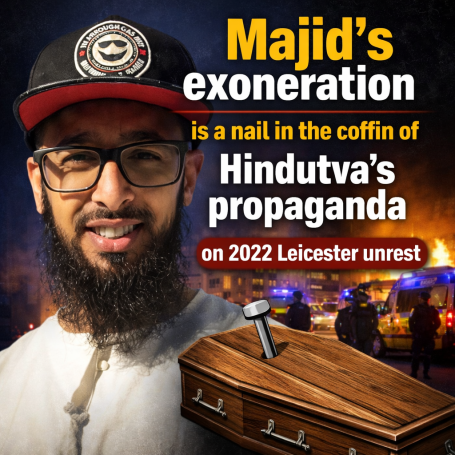
We welcome the exoneration of Majid Freeman
Leicester Crown Court in relation to a public order offence arising from the 2022 Leicester unrest busting Hindutva propaganda.
This judgment decisively overturns the earlier lower-court conviction and marks an important moment of justice.
The ruling brings to an end sustained attempts by Hindutva-aligned networks to misrepresent the events of 2022 by projecting Muslim individuals as perpetrators while obscuring their own role. These efforts sought to whitewash Hindutva involvement in organising an unplanned march, fostering a hostile atmosphere, and carrying out racially motivated attacks in long-standing neighbourhoods across Leicester.
The court rightly acknowledged Mr Freeman’s positive role, noting that he had been, on multiple occasions, “a bridge-builder, working with the police, to ensure there was harmony in his community.” This finding stands in stark contrast to the Islamophobic narratives promoted by far-right Hindutva platforms which pursued a campaign of vilification against him.
This verdict is not only a personal vindication for Majid Freeman but also a clear repudiation of disinformation that sought to criminalise Muslims and distort the reality of the 2022 unrest. It underscores the need for accountability, accurate reporting, and an end to the weaponisation of the justice system for sectarian propaganda.

The United Kingdom Indian Muslim Council (UK-IMC) Statement on the Attack at East Sussex Mosque
The United Kingdom Indian Muslim Council (UK-IMC) unequivocally condemns the violent attack on a mosque in East Sussex. This appalling act is not only an assault on a sacred place of worship but also a racist, Islamophobic act of terror intended to harm, intimidate, terrorise, and instill fear among the members of Muslim community in the UK.
The arson at East Sussex Mosque is not an isolated incident, but one among more than a dozen anti-Muslim hate crimes reported in just the past five weeks.
We extend our deepest solidarity to the Muslim community of East Sussex and all those affected. No one in Britain should ever fear practising their faith or gathering in worship.
This incident is part of a deeply troubling rise in Islamophobic hate crimes across the United Kingdom. It mirrors a wider global pattern of hostility towards Muslims, fuelled by online disinformation, far-right narratives, and transnational networks of hate.
UK-IMC calls upon the Home Office, local authorities, and law enforcement agencies to conduct a thorough and transparent investigation, ensure that those responsible are held accountable, and take urgent steps to safeguard Muslim places of worship nationwide. We urgently call for the criminalisation of Islamophobia, fully adopting the APPG definition, as these are not merely hate crimes but racially motivated attacks.
The attack on the East Sussex mosque is a reminder that Islamophobia is not random — it is systemic, organised, and emboldened by right-wing narratives, and global hate networks. The government must take decisive action to confront this threat and reaffirm that there is no place for hate in Britain.
The United Kingdom Indian Muslim Council urges:
• Robust monitoring and reporting of Islamophobic hate incidents and extremist activity.
• Stronger enforcement and legislation to tackle hate speech both online and offline.
UK-IMC stands firmly with British Muslims and all communities who reject hate and uphold the values of justice, equality, and mutual respect that define a plural, democratic Britain.
Our thoughts and prayers are with the worshippers, their families, and the East Sussex community during this difficult time.
Media Contact:
United Kingdom Indian Muslim Council (UK-IMC)
📧 info@ukimc.org 🌐 www.ukimc.org
Official Statement from the UK-IMC Regarding the Air India Flight Incident
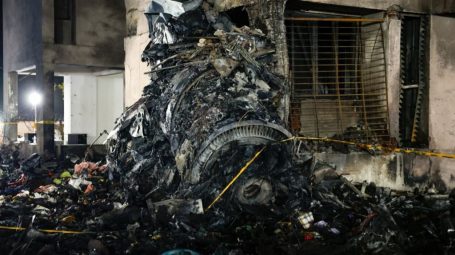
The United Kingdom Indian Muslim Council offers its sincerest condolences and profound prayers to all individuals impacted by the tragic incident involving the Air India flight from Ahmedabad to Gatwick Airport, London.
This devastating incident, described as the most tragic air crash in a decade, has deeply impacted families across communities, particularly members of the Gujarati diaspora, as they are the most impacted according to the media reports. We are especially saddened to learn that among the victims are many UK citizens of Indian origin who have lost their lives or their loved ones.
As more details emerge, we stand in solidarity with all the bereaved families during this unimaginably difficult time. Our thoughts and prayers are with them, and we pray that all those who have passed find peace, and their families find strength and comfort.
The UK-IMC urges community members to come together in support, offering whatever help and compassion we can to all those in mourning. We also call upon relevant authorities to provide timely assistance and transparent information to the families impacted.
May God grant patience and healing to all those who are grieving.
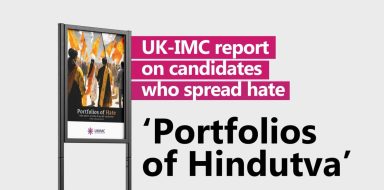
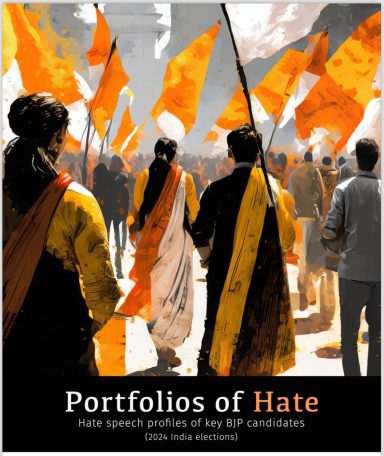
'Portfolios of Hate' is out
The report reveals venomous hate and Islamophobia utilised to gain or retain power in India has doubled.
‘Portfolios of Hate’ comprises a curated list of non-exhaustive of 70 instances of hate speech, meticulously recorded by national media houses from across various regions in India. Of the 70 incidents analysed, involving 36 personalities, a striking trend emerges. During the first term of the BJP-led NDA government (2014-2019), 23 incidents of hate speech were recorded. However, this number doubled during the second term (2019-2024), with 47 cases reported.
This significant surge in hate speech instances underscores the re-ascendance of Hindutva ideology to parliamentary power. It has emboldened politicians to propagate Islamophobia, Xenophobia, and other forms of targeted hate with impunity.
The cost of hate:
In many cases, the verbal and symbolic violence of leaders has translated into physical violence by followers on the ground. Hindu religious festivals and mythological references are often invoked to vilify Muslims and other religious minorities.
Broad categories of hate speech:
While the primary focus of the report is on Islamophobia and anti-Muslim hatred, the incidents included in the document fall into broader categories:
- Islamophobic disinformation campaigns and calls for violence against Muslims.
- Targeted campaigns for violence and social boycotts against religious minorities.
- Speech reflecting patriarchal and misogynistic attitudes towards women.
- Anti-immigrant hate speech to instill fear and foster collective hate.
- Hate and disinformation campaigns against farmers and other marginalized sections protesting authoritarian laws.
By raising awareness about the prevalence and implications of hate speech, we hope to foster dialogue and promote tolerance in our society.
'Portfolios of Hate' released
Here is the video of the launching of our first report of the year ‘Portfolios of Hate. We explain here the key findings of the report
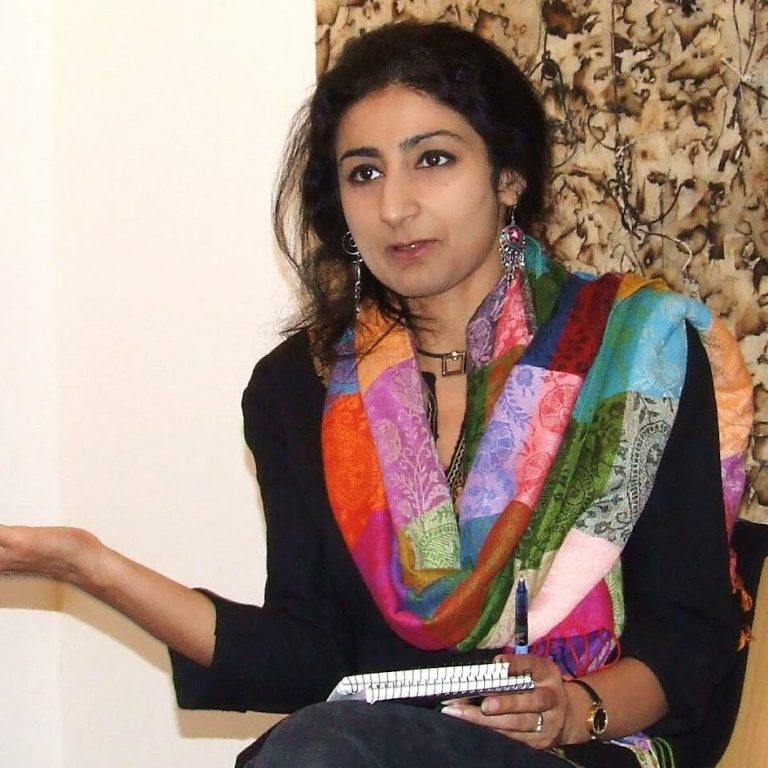
“Denied entry to India for speaking on democratic & constitutional values. I was invited to a conference as esteemed delegate by Govt of #Karnataka (Congress-ruled state) but Centre refused me entry. All my documents were valid & current (UK passport & OCI)”
Prof. Nitasha Kaul, on her deportation

UK-IMC statement in support of Professor Nitasha Kaul
26 Feb 2024
We urge the British government to challenge the deportation of UK Professor Nitasha Kaul and the ongoing attempts of the Indian government to suppress academic freedom
Prof Kaul's deportation is part of a concerning trend of silencing dissenting voices that challenge the authoritarian actions of the Indian government and highlight the Indian government's fragility and oppressive stance against free exchange of ideas.
Professor Nitasha Kaul, a respected scholar in Politics, International Relations and Critical Interdisciplinary Studies at the University of Westminster, was in Bangalore at the request of the state government of Karnataka to discuss democratic and constitutional principles. She has been a vocal defender of minority rights in India and a critic of Hindutva (a Hindu supremacist ideology).
The Hindutva regime in India has previously demonstrated similar fragility and authoritarianism towards academia. For instance, in 2022, Filippo Osella, a professor at the University of Sussex in the UK, was forcibly removed from Thiruvananthapuram airport.
As an advocacy movement committed to protecting the rights of Indian Muslims and other minorities while opposing Hindutva and other extremist ideologies, the UK-Indian Muslim Council firmly condemns these cowardly attempts to curtail academic freedom. It is crucial to nurture environments that value diverse viewpoints, critical thinking, and open discussions.
We express unwavering support for Professor Nitasha Kaul and all scholars facing similar challenges in exercising their academic freedom and call on the UK government to confront India's violation of scholars' rights and their essential role in educating and engaging with the public.